THE NEW PRIESTHOOD OF POWER
Elite Networks, Billionaire Immortality, and the Modern Desire to Transcend Human Limits
Yes. For a book, this material needs to be transformed from a collection of assertions into a documented chapter that clearly separates verifiable elite networking, historical organizations, emerging longevity science, speculation about hidden control, and your theological interpretation of 2 Thessalonians 2.
The source document itself moves through three major subjects: elite gatherings and societies, billionaire practices, and longevity/anti-aging research, before concluding that these developments are part of the biblical “strong delusion.”
THE NEW PRIESTHOOD OF POWER
Elite Networks, Billionaire Immortality, and the Modern Desire to Transcend Human Limits
There has always been an elite.
Kings gathered in royal courts. Aristocrats formed exclusive social circles. Merchants created guilds. Political leaders established clubs and private associations. Wealthy families married into other wealthy families. Universities created alumni networks through which friendships could become business relationships, political alliances, and avenues into influential institutions.
The twenty-first century has not abolished this phenomenon.
It has modernized it.
The old aristocratic dinner may now be an invitation-only technology conference. The gentleman's club may become a private investment network. Industrial fortunes have been joined by fortunes produced through software, artificial intelligence, venture capital, biotechnology, private equity, aerospace, cryptocurrency, and data.
The essential sociological principle remains remarkably durable:
Power creates networks, and networks can reproduce power.
But that observation must not automatically become the stronger claim that every gathering of powerful people constitutes a secret government.
That distinction is crucial.
1. Elite Social Rituals Still Matter
The original material argues that elite rituals continue to regulate access to powerful social networks.
There is a reasonable sociological insight here.
Access matters.
Relationships matter.
Reputation matters.
Education matters.
Introductions matter.
Being physically present where investors, executives, politicians, academics, philanthropists and institutional leaders meet can produce opportunities unavailable to outsiders.
This is not necessarily conspiracy.
It is social capital.
A person with money possesses financial capital.
A person with expertise possesses intellectual capital.
But someone who can telephone governors, CEOs, financiers, university presidents and media executives possesses another kind:
network capital.
And network capital can translate into real influence.
2. Davos: Power in Proximity
The document presents the World Economic Forum's Davos meeting as a gathering of political leaders, CEOs, billionaires and policymakers where important informal interactions occur.
That basic description can be documented, although some of the original language needs qualification.
The 2026 World Economic Forum Annual Meeting brought together close to 3,000 participants from more than 130 countries, including roughly 400 political leaders, nearly 65 heads of state or government and approximately 850 major CEOs and chairs. Civil society, labor, religious organizations, academics and other groups also participated.
The Forum itself acknowledges the importance of conversations outside the formal program and notes that Davos has provided a setting for business partnerships and political breakthroughs. It simultaneously states that the Forum does not dictate government policy.
This gives us a much more defensible formulation than:
“Davos secretly decides world policy.”
The documented conclusion is:
Davos places unusually powerful people in unusually concentrated proximity to one another, creating opportunities for formal and informal agenda-setting, relationship-building, negotiation, and collaboration.
That is significant without requiring us to claim more than the evidence demonstrates.
3. Bilderberg: Secrecy, Privacy, and Influence
The document describes the Bilderberg Meeting as a closed gathering of political, financial, corporate and military figures.
The meeting is real.
Its privacy is real.
Its influential participants are real.
But the original document asks whether Bilderberg amounts to a kind of “shadow government.” That conclusion is not established merely by the existence of private meetings.
Bilderberg's own published description says approximately 120–140 political leaders and experts from government, finance, industry, academia and media participate annually. Discussions occur under the Chatham House Rule, meaning participants may use information obtained there but may not identify who made particular remarks. Bilderberg says there are no resolutions, votes or official policy statements.
Interestingly, its 2026 topics included AI, digital finance, China, Russia, Ukraine, the Middle East, energy, future warfare and the transatlantic defense-industrial relationship.
That certainly makes Bilderberg worthy of serious study.
But a book should distinguish:
DOCUMENTED: influential people privately discuss major geopolitical questions.
from:
POSSIBLE: relationships and ideas developed there may later influence decisions.
from:
UNPROVEN: Bilderberg collectively determines government policy or selects national leaders.
That three-level distinction will make your argument much harder to dismiss.
4. Bohemian Grove and the Power of Ritual
The source also discusses Bohemian Grove, portraying it as a private retreat associated with prominent political and business figures and highlighting the theatrical “Cremation of Care” ceremony.
The broader issue raised here is fascinating:
Why do elites still use ritual?
Modern technological society likes to imagine itself as completely rational.
Yet human beings continue to organize themselves around:
symbols,
ceremonies,
traditions,
uniforms,
initiations,
exclusive spaces,
shared stories,
and insider language.
Ritual creates belonging.
Belonging creates trust.
Trust creates networks.
Networks can facilitate cooperation.
Therefore, ritual should not automatically be interpreted as supernatural activity or evidence of coordinated political conspiracy.
But neither should ritual be dismissed as meaningless.
Ritual helps create group identity.
And group identity can reinforce social power.
5. Skull & Bones and Elite Reproduction
The document describes Yale's Skull & Bones as an elite society associated historically with prominent political and business figures.
Again, the strongest argument isn't:
“They secretly control everything.”
It is:
elite institutions can produce durable networks.
A university friendship can become a professional relationship.
A professional relationship can become a business partnership.
A business relationship can become political support.
Political connections can generate further access.
Access can reproduce access.
This is how influence can persist even without a centralized conspiracy.
The system doesn't always require somebody sitting in a dark room giving orders.
Sometimes networks themselves reproduce privilege.
6. The Illuminati Requires a Different Category
Here the original material needs substantial correction before publication.
It acknowledges that the modern Illuminati is largely considered conspiratorial while connecting its mythology to contemporary fears about elite global control.
The historical Bavarian Illuminati was real.
But claims that it survived and now secretly controls contemporary governments, banking, entertainment or global institutions require evidence that is generally absent.
A book should therefore distinguish the:
historical Illuminati
from the:
modern Illuminati mythology.
The mythology itself is worth studying because it reveals widespread anxiety about concentrated power.
But mythology cannot be presented as documented institutional continuity without evidence.
7. Freemasonry: History Versus Omnipotence
The source similarly describes Freemasonry as historically associated with politicians, military figures and other prominent individuals.
That historical subject is legitimate.
But again:
membership among influential people does not prove centralized control over those people's actions.
This principle needs to run throughout the chapter:
Association demonstrates association. It does not automatically demonstrate command.
That simple methodological rule protects the book from turning correlation into conspiracy.
8. The Elite Has Changed
The source makes a particularly important observation when it moves from old-money elites to technology billionaires.
Yesterday's elite power centered heavily around:
land → banking → railroads → steel → oil → manufacturing → newspapers.
Today's elite increasingly includes control over:
software → data → algorithms → cloud infrastructure → artificial intelligence → biotechnology → aerospace → digital finance → communications platforms.
This represents a profound transformation.
The modern technology billionaire may possess something earlier industrial magnates could scarcely imagine:
infrastructure capable of mediating the behavior, communications, purchases, movements and information environments of billions of human beings.
That doesn't make technology executives omnipotent.
But it does make the concentration of technological infrastructure a legitimate political and ethical question.
9. The Billionaire Bunker Phenomenon
The document then turns toward private islands, bunkers and elite “escape plans,” interpreting them as preparation for political instability, economic collapse or environmental disaster.
This theme should be handled carefully because individual claims about who owns which island or bunker vary substantially in evidentiary quality.
But the broader phenomenon raises an important philosophical question.
If the people benefiting most from a civilization become deeply concerned about surviving its potential collapse, what does that reveal about their expectations?
There is an enormous difference between:
building resilient civilization
and:
building private escape routes from civilization.
The bunker therefore becomes an extraordinarily powerful literary symbol.
It represents:
PRIVATE SALVATION WITHOUT PUBLIC RESTORATION.
Theologically, that concept will become important later.
10. The Space Race: Wealth Reaches Beyond Earth
The document describes Elon Musk, Jeff Bezos and Richard Branson as representatives of the billionaire commercial space race.
The original text interprets this primarily as an effort to commercialize space for wealthy people.
That is too narrow.
Commercial space companies pursue multiple objectives, including launch services, satellites, communications, scientific missions, government contracts, exploration, tourism and long-term human settlement.
But something historically extraordinary is occurring nevertheless.
For most of history, only states possessed the resources necessary to reach space.
Today, private fortunes and corporations can finance capabilities once associated almost exclusively with superpowers.
That represents a genuine transfer of technological capacity.
11. The Most Important Development: The War Against Aging
Here the document becomes especially relevant to your larger theological argument.
It says that some wealthy technology figures increasingly approach aging not merely as something to endure but as a biological problem potentially susceptible to technological intervention.
That observation is substantially supportable.
Calico, founded with Google's support in 2013 and now associated with Alphabet, states that its mission is to understand the biology controlling human aging and develop interventions that enable longer and healthier lives.
Its current work combines biological research, computational biology, machine learning and drug development.
This is important.
But notice what Calico does not claim.
It does not claim to possess immortality.
It does not claim death has been conquered.
It does not claim humans can currently live indefinitely.
Its stated objective concerns understanding aging and increasing healthspan and longevity.
That distinction should remain explicit throughout the book.
12. Bryan Johnson: The Body as Engineering Project
The document then uses Bryan Johnson as an example of extreme personal experimentation in longevity, describing intensive monitoring, supplementation, diet and other interventions.
Whether one admires or criticizes Johnson's approach, he represents something culturally significant.
The body is increasingly imagined as a system to optimize.
Sleep becomes data.
Heart rate becomes data.
Blood chemistry becomes data.
Exercise becomes data.
Food becomes data.
Biological age becomes a metric.
The human organism increasingly becomes something that can be:
measured → modeled → predicted → optimized → modified.
That represents a profound philosophical transition.
Medicine traditionally asks:
How do we cure disease?
The technological imagination increasingly asks:
HOW FAR CAN WE REENGINEER THE HUMAN CONDITION ITSELF?
13. Healthspan Is Not Immortality
This distinction is absolutely essential for a documented book.
The source repeatedly uses dramatic language such as “biological immortality,” “eternal youth,” and billionaires potentially living for centuries.
Those are presently speculative possibilities, not demonstrated scientific achievements.
There is legitimate research into aging.
There are legitimate interventions capable of improving health.
There is legitimate investigation into cellular senescence, metabolism, genetics and age-related disease. Calico explicitly describes this research agenda.
But:
longer healthspan ≠ radical life extension
and:
radical life extension ≠ immortality.
A scientifically responsible chapter must preserve those distinctions.
14. The Real Ethical Question: Who Gets the Technology?
Here the original document raises one of its strongest questions.
It asks whether successful longevity technology would become broadly available or remain an elite privilege.
That is not conspiracy theory.
It is a legitimate distributive-justice question.
Every transformative medical technology raises questions about:
cost,
insurance,
patents,
availability,
geography,
health inequality,
public funding,
and access.
Suppose future biotechnology could reliably add twenty healthy years to human life.
Who receives it first?
The billionaire?
The insured?
Citizens of wealthy nations?
Everyone?
And what happens during the decades between invention and widespread affordability?
Those are serious questions.
15. The Ultimate Form of Inequality
Ordinary inequality concerns differences in:
money,
housing,
education,
food,
healthcare,
security,
and political influence.
But radical longevity would introduce something qualitatively different:
INEQUALITY OF TIME.
Imagine one social class routinely living dramatically longer healthy lives than another.
Wealth would no longer merely purchase a larger house.
It would purchase more life in which to accumulate additional wealth.
Leadership turnover could slow.
Inheritance could be postponed.
Fortunes could compound longer.
Institutional power could remain concentrated in the same hands for greater periods.
Again, we are discussing a hypothetical future—not an existing reality.
But the ethical implications are enormous.
16. The Ancient Human Dream Behind Modern Longevity
This is where your chapter can become much deeper than simply cataloguing billionaires.
The desire to escape death isn't new.
Technology is new.
The desire isn't.
Ancient rulers searched for immortality.
Mythologies imagined fountains of youth.
Alchemy pursued elixirs.
Religions wrestled with mortality.
Pharaohs constructed monumental tombs.
The Epic of Gilgamesh revolves partly around the human terror of death.
Modern biotechnology therefore represents an ancient aspiration equipped with unprecedented tools.
The laboratory has replaced the alchemist's chamber.
The genome has replaced the magical elixir.
Artificial intelligence can assist biological research.
But the ancient question remains:
CAN MAN DEFEAT DEATH?
17. Scripture Gives a Very Different Answer
Here we reach the theological heart of your argument.
Biblically, death is not merely an engineering defect.
It belongs to the theological problem of fallen humanity.
The Christian proclamation therefore doesn't ultimately promise salvation through optimization.
It promises resurrection.
That difference is enormous.
Technological longevity says:
Preserve the present biological life as long as possible.
The gospel declares:
Death itself will ultimately be defeated through the Messiah.
Paul's language in 1 Corinthians 15 is therefore radically different from transhumanist aspirations:
“The last enemy that shall be destroyed is death.”
Human beings don't conquer that final enemy through wealth.
YAHUAH conquers it.
18. From Longevity to the “Strong Delusion”
The source makes its largest theological leap at the end:
“This [is] a major part of the strong delusion that Yahuah is using on the wicked.”
It then quotes 2 Thessalonians 2:7–12, describing the mystery of iniquity, the Wicked one, satanic signs and lying wonders, deception, rejection of truth and the “strong delusion.”
This should be identified explicitly in the book as the author's prophetic interpretation.
Paul does not explicitly identify:
Calico,
biohacking,
billionaires,
artificial intelligence,
longevity research,
Davos,
Bilderberg,
or biotechnology
as the strong delusion.
Therefore we should not write:
“2 Thessalonians 2 predicts billionaire longevity research.”
The text does not say that.
Instead, the stronger formulation is:
The author sees an analogy between Paul's warning about humanity embracing deception rather than truth and the modern technological temptation to believe that human ingenuity can ultimately transcend the limits of creaturehood without reconciliation to the Creator.
That is a theological argument.
And stated that way, it becomes much stronger.
19. What Is the “Strong Delusion” in Context?
The crucial language in 2 Thessalonians isn't simply that people are deceived.
Paul gives a moral reason:
They “received not the love of the truth.”
And later:
They “had pleasure in unrighteousness.”
That means the delusion is connected to desire.
People don't merely encounter inaccurate information.
They become susceptible to deception because deception corresponds with something they want.
That gives your longevity argument an interesting theological dimension.
Suppose humanity desperately wants to believe:
We don't need God.
We don't need resurrection.
We don't need repentance.
We don't need divine transformation.
We can engineer our own salvation.
Then technology could become more than a tool.
It could become a soteriology—a doctrine of salvation.
That is the theological danger your source is reaching toward.
20. Technology Is Not Automatically the Delusion
This qualification is equally important.
Medicine isn't rebellion against YAHUAH simply because it prolongs life.
Antibiotics prolong life.
Heart surgery prolongs life.
Cancer treatments prolong life.
Insulin prolongs life.
Sanitation prolongs life.
Improved nutrition prolongs life.
Scripture does not command humanity to avoid healing because mortality exists.
Therefore the moral issue cannot simply be:
“They are trying to live longer.”
The deeper issue is:
WHAT DOES HUMANITY BELIEVE TECHNOLOGY CAN SAVE US FROM?
If longevity science alleviates suffering and extends healthy life, it can be understood as medicine.
If technological ideology begins promising that humanity can transcend death, morality, creaturehood and dependence upon God, it starts functioning more like a rival religion.
That distinction is essential.
21. The New Tower of Babel
The Tower of Babel offers a stronger theological parallel than many modern conspiracy narratives.
Babel combines:
human coordination,
technological capacity,
centralization,
ambition,
self-exaltation,
and the desire to “make us a name.”
The problem isn't that bricks are evil.
The problem is what humanity intends to accomplish through them.
Likewise:
AI is a tool.
Biotechnology is a tool.
Finance is a tool.
Spaceflight is a tool.
Medicine is a tool.
Networks are tools.
The biblical question is always:
WHOSE PURPOSE DOES THE TOOL SERVE?
Technology becomes spiritually dangerous when humanity's accomplishments become the foundation for declaring independence from its Creator.
22. The New Elite Does Not Merely Want Wealth
This is where the various parts of the source can finally be connected.
Traditional wealth purchased:
land,
mansions,
servants,
luxury,
art,
political access.
Twenty-first-century technological wealth can aspire toward something much larger:
control over information,
control over computational infrastructure,
control over biological knowledge,
control over advanced medicine,
control over space infrastructure,
and perhaps eventually greater control over the biological processes associated with aging.
The ambition of wealth therefore expands from:
“How much can I own?”
toward:
“HOW MUCH OF REALITY CAN HUMAN TECHNOLOGY CONTROL?”
That is a far more important question than whether billionaires attend strange parties.
23. The Paradox of the Technological Elite
There is an extraordinary paradox here.
Humanity possesses greater scientific knowledge than any previous civilization.
Yet it remains confronted by exactly the same fundamental realities faced by ancient humanity:
suffering,
aging,
fear,
loneliness,
moral corruption,
meaning,
and death.
A billionaire can own companies.
He cannot purchase yesterday.
A technologist can build artificial intelligence.
He cannot program himself back into youth.
A biotechnology company may learn extraordinary things about aging.
It has not abolished mortality.
The richest person and poorest person eventually confront the same ancient boundary.
That is why the biblical question remains devastatingly relevant:
“For what shall it profit a man, if he shall gain the whole world, and lose his own soul?”
24. A Better Framework for Your Book
I would organize the evidence throughout this chapter into four clearly marked categories:
DOCUMENTED FACT: Davos, Bilderberg, Calico, elite networks and longevity research demonstrably exist.
REASONABLE INFERENCE: Private elite networks can generate access, influence, relationships and opportunities unavailable to ordinary citizens.
SPECULATION: Claims that particular gatherings secretly dictate world government, choose leaders, or coordinate a unified global agenda require evidence beyond their exclusivity.
THEOLOGICAL INTERPRETATION: The connection between technological self-transcendence and Paul's “strong delusion” is a prophetic reading of contemporary developments—not something 2 Thessalonians explicitly identifies.
That framework would actually make the prophetic argument more powerful, because readers always know where the evidence ends and interpretation begins.
The Larger Question: Can Man Save Himself?
This entire subject ultimately converges on something far greater than Davos, Bilderberg, secret societies or billionaire biohackers.
The central question is:
WHAT HAPPENS WHEN MAN'S GREATEST TECHNOLOGICAL ACHIEVEMENTS BEGIN TO FUNCTION AS A SUBSTITUTE FOR GOD?
Human beings have always wanted security.
Now technology promises prediction.
Human beings have always feared sickness.
Now biotechnology promises intervention.
Human beings have always feared aging.
Now longevity science investigates whether aging processes can be slowed or altered.
Human beings have always feared death.
And some technological visions increasingly imagine death itself as a problem that sufficiently advanced intelligence might someday overcome.
That is where your theological argument becomes most compelling.
The danger isn't scientific discovery.
The danger isn't medicine.
The danger isn't long life.
The danger isn't wealthy people knowing one another.
The danger is idolatry—when humanity takes legitimate powers of stewardship and transforms them into a rival doctrine of salvation.
The strongest version of the chapter therefore does not say:
“The billionaires have discovered immortality.”
They haven't.
It says something considerably more profound:
Humanity may possess unprecedented technology while remaining vulnerable to its oldest temptation—the promise that man can become his own god, construct his own salvation, overcome his own limitations, and ultimately escape judgment without submitting to YAHUAH.
And that brings us directly back to the language your source chose to end with:
“They received not the love of the truth.”
In your book's theological framework, that—rather than any particular billionaire, conference, company, or scientific experiment—is the real danger of the strong delusion.
KELVIN L. STUBBLEFIELD IS A GRADUATE OF Middle Tennessee State University IN 1983.
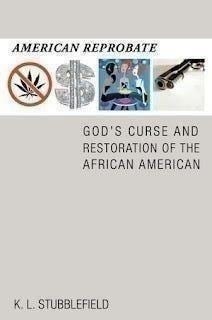
HE IS THE AUTHOR OF “AMERICAN REPROBATE: YAHUAH’S CURSE AND RESTORATION OF THE AFRICAN AMERICAN”. THAT WAS PUBLISHED IN 2012.

HE AND HIS WIFE SANDRIA, CO-FOUNDED “BIGSTUB CREATIONS” IN 2018. We are a vehicle for creativity! Our mission is to encourage individuals to utilize their artistic expression through the performing arts.
He has recently published his second book in November 2023.

STAYING HUMAN: EXAMINING THE RELATIONSHIP BETWEEN YAHUAH, MAN AND ARTIFICIAL INTELLIGENCE”.
Biblical, Spiritual, and Social Analysis and Solutions to Black Americans and Mainstream AMERICAN Dysgenics, Narcissistic Self Indulgence, and the Current Politics of Self Annihilation. Amidst the dawning of Artificial General intelligence and Trans-Humanity.
YOU CAN PURCHASE HIS PUBLICATIONS OR LEARN ABOUT OUR NEXT PROJECT; YOU CAN VISIT THE FOLLOWING WEBSITES.
https://www.klstubblefield.com/
Staying Human
https://www.bigstubcreations.com/
https://loveintheblack.blogspot.com/
https://lovingmyhumans.blogspot.com
https://kelvinstubblefield.substack.com/publish/post/14776577
CASHAPP DONATIONS: $BIGSTUB
COMING SOON, YAHUAH WILLING
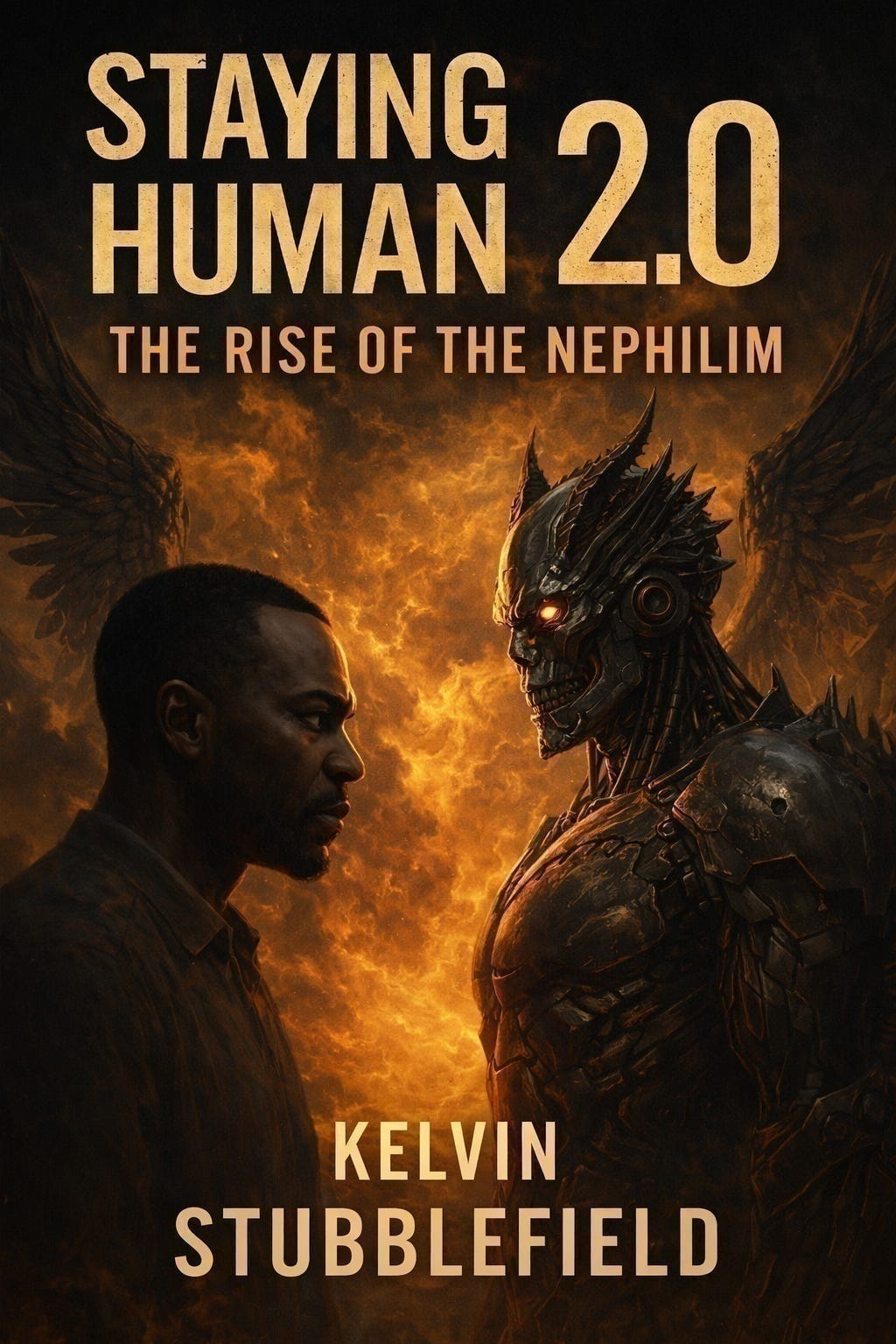
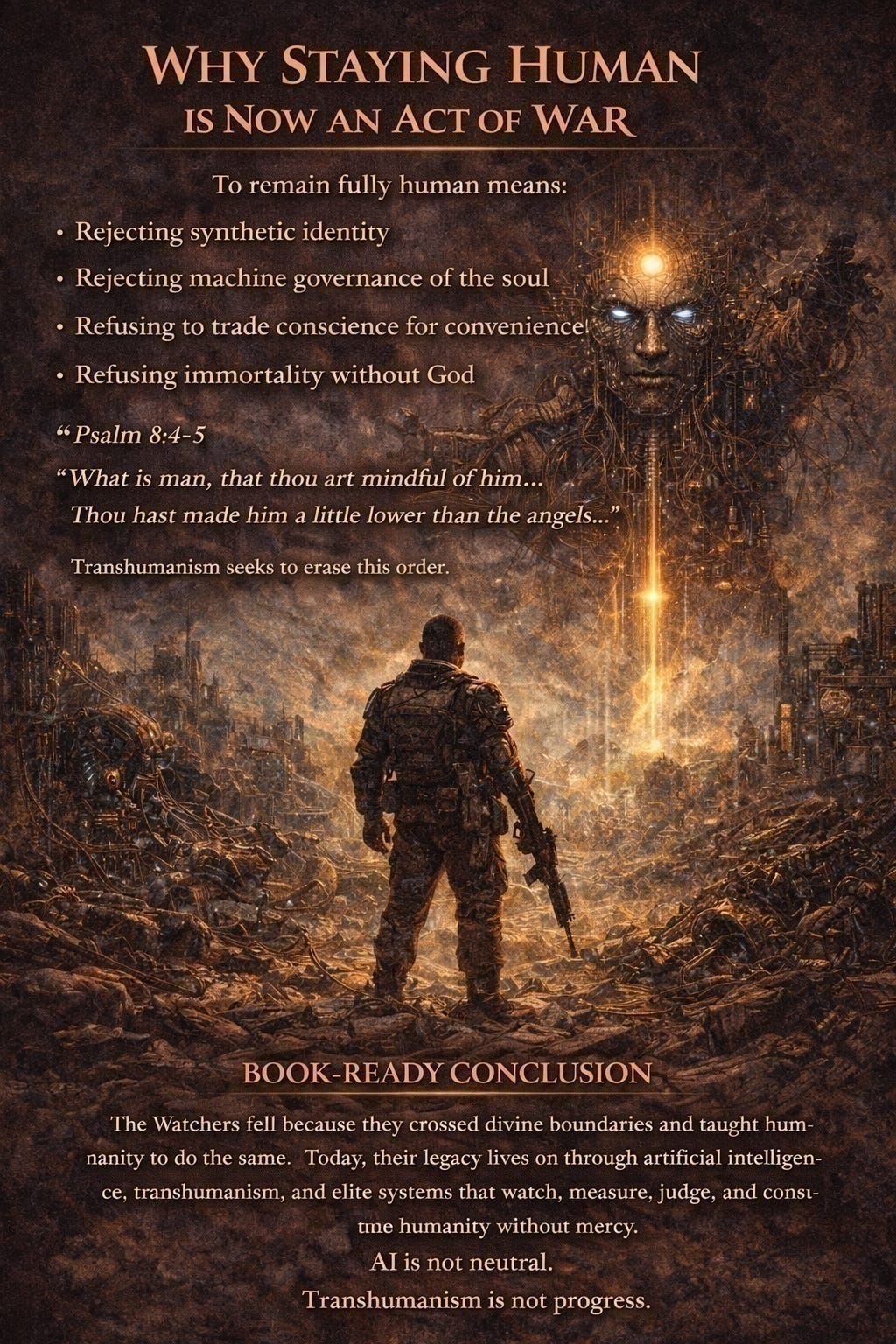
JOIN KELVIN’S FIGHT TO STAY HUMAN! is a reader-supported publication. To receive new posts and support my work, consider becoming a free or paid subscriber.


No comments:
Post a Comment